High volatility | Bankroll & Session Tips
Crabby Collector Strategy Guide
No betting pattern changes the 96.27% RTP in Crabby Collector — the useful variables are bankroll sizing, bet level selection, and the decision whether to use Bonus Buy. These guidelines focus on session discipline for a 4/5 high-volatility collection slot, not on beating the math.
Bankroll sizing for this volatility
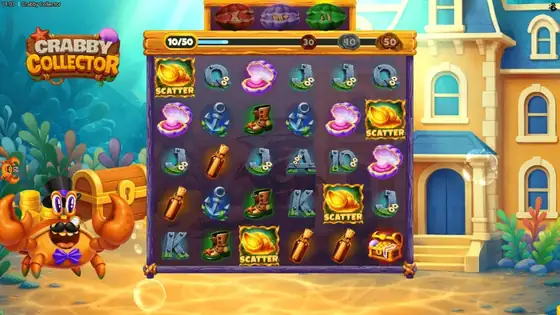
Crabby Collector is rated 4/5 — high, but not maximum. I plan sessions around 100–150× my chosen stake as a working bankroll: enough cushion for the long gaps between meaningful chains on an 8-symbol minimum cluster grid, without the extreme runway a 5/5 title might need. At €0.10 per spin that is €10–€15; at €50 it is €5,000–€7,500. Bet size does not change the 96.27% RTP, but it defines the monetary ceiling: 15,000× at €0.10 caps at €1,500, while the same multiplier at €50 reaches €750,000. Choosing your stake is therefore choosing your upside scale, not your odds. Keep each spin at or below 1% of your session total so one bad streak does not erase the budget in a handful of spins. Bonus Buy at 100× stake only makes sense with a bankroll of 200× or more — treat each purchase as 10–15% of your session budget at most, so a miss leaves room to continue or buy again without chasing.
Flat vs progressive betting
Flat betting (recommended)
- Keep the same stake on every spin so session length stays predictable and easy to track against your pre-set loss limit.
- Flat stakes prevent emotional escalation after a chain stalls at 27 on the Collection Counter or after a small booster hit — the most common path to overspending on high-volatility grids.
- Because RTP is fixed at 96.27%, the only lever you control is how many spins your bankroll funds at a comfortable bet level.
Progressive betting (not recommended)
- Doubling stakes after losses — martingale-style progressions — does not change the math model and can exhaust a 100× bankroll in a few bad cascades on a 6×5 grid.
- Raising bets to 'catch' a bonus round is a myth: organic trigger timing is random and unrelated to stake changes within the published bet range.
- If you feel tempted to increase stakes to recover losses, pause the session. Progressive patterns are bankroll risk, not strategy.
Time and loss limits
- Set a hard loss cap before opening the game, expressed as a multiple of your per-spin stake — for example, stop after losing 80× your bet regardless of how the session feels.
- Pair that loss limit with a time ceiling of 45–60 minutes so fatigue does not erode the discipline you set at the start.
- Use the in-game clock or a phone timer; when either limit trips, close the session even if you are mid-bonus or on a winning streak.
- Write both limits down or enable casino deposit tools if available. Treating them as non-negotiable rules is what separates recreational play from problem patterns.
- Review limits monthly and tighten them if sessions routinely end at the cap. Sustainable entertainment matters more than recovering prior losses.
Use the demo to learn the rhythm
I recommend at least 200 demo spins at your intended real-money stake before funding a session. Crabby Collector's Collection Counter rhythm — how quickly chains approach 30, 40 and 50 — is easier to calibrate in free play than to discover with a live balance. Run one full bonus round in demo, either organically or via Bonus Buy, to see how the Global Multiplier accumulates across spins. Note the largest single-chain swing relative to your bet; if the demo already feels too volatile for your comfort, lower your stake proportionally before switching to real play.
After a big win
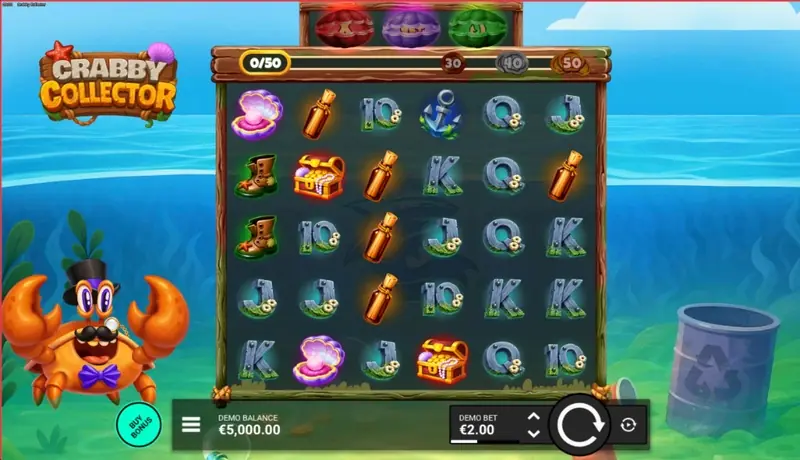
When a large multiplier lands — especially a Tier 3 booster chain in the bonus round — withdraw or set aside at least half of the profit above your starting session bankroll. The game does not remember the previous round; the next spin carries the same house edge. Take a break before continuing. Euphoria after a big hit is when many players raise stakes and give back winnings. Treat any remaining play money as a fresh session with the same flat stake and limits you planned at the start.